Dar ul Tarikh
A personal history and geopolitics platform that explains the present by tracing what came before — in active development.
View live site →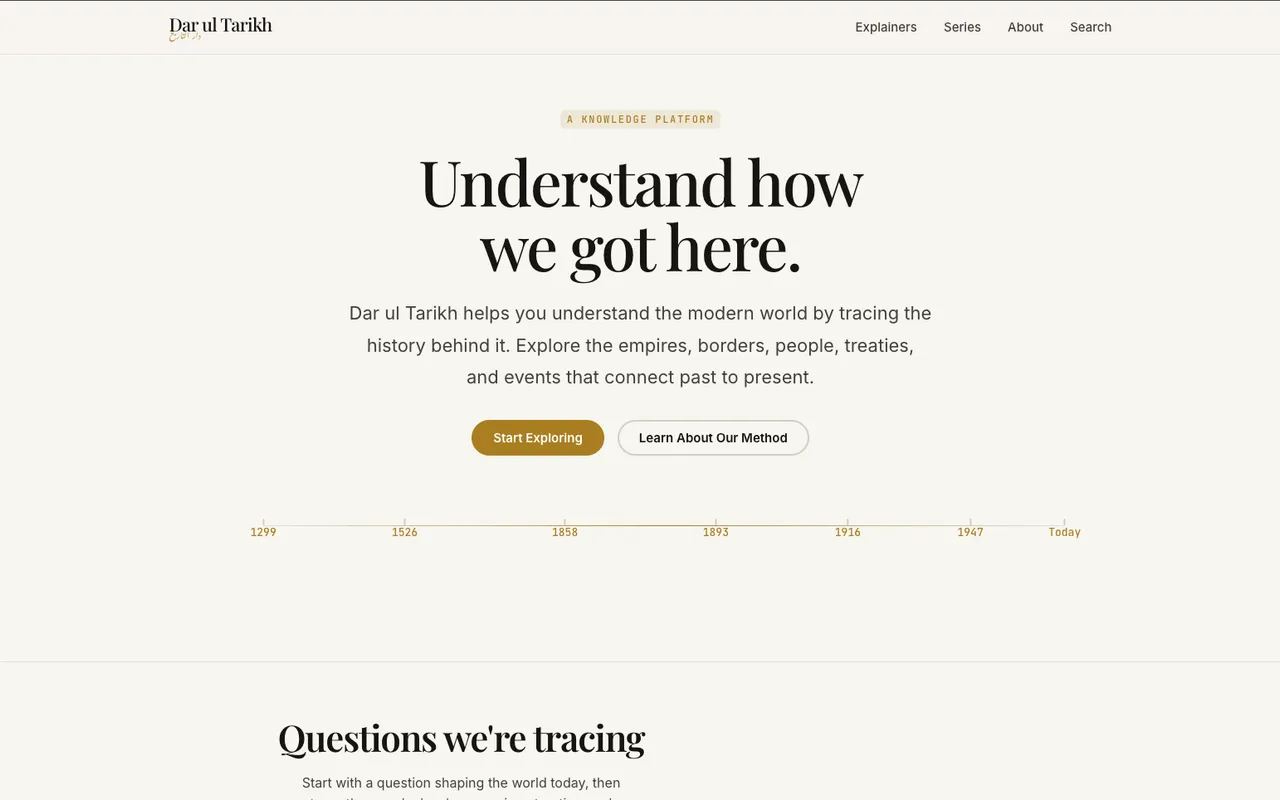
Overview
A personal knowledge platform — Arabic for “House of History” — built to explain the present by tracing the past.
Status: in active development. Phases 0–3 are complete; search, additional explainers, and entity expansion are planned.
What it does
- Explainers — modern questions traced backward through treaties, empires, and events
- Series — the first being The Ottoman Collapse and the Modern Middle East
- Entities — eighteen connected reference pages, cross-linked at build time
- Connection chains — present-day disputes linked to their historical causes
Built with
Astro 5, strict TypeScript, MDX content collections, a custom CSS design system, and an AI-assisted workflow in ShipStudio + opencode.
Challenge
History content is dense and easy to lose readers in. On top of that, the site needed a content architecture — explainers, entities, and series — where cross-references resolve reliably at build time, while keeping politically sensitive material sourced and neutral.
Approach
Designed a question-first structure: every explainer starts from a modern question and traces backward through events, treaties, and empires. Built in Astro 5 with strict TypeScript, MDX content collections, and a custom vanilla-CSS design system. Relationships between explainers and entities resolve at build time. Developed through an AI-assisted workflow in ShipStudio + opencode, shipped in phases so it stays usable at every stage.
Solution
A live, multi-section platform: six sourced explainers, eighteen connected historical entities, and a three-part series on the Ottoman collapse — with search, more series, and richer visualization still to come.
Results
- Phases 0–3 shipped — live and in active development
- Six sourced explainers live on a question-first structure
- Eighteen connected entities with build-time relationship resolution
- First series live: The Ottoman Collapse and the Modern Middle East